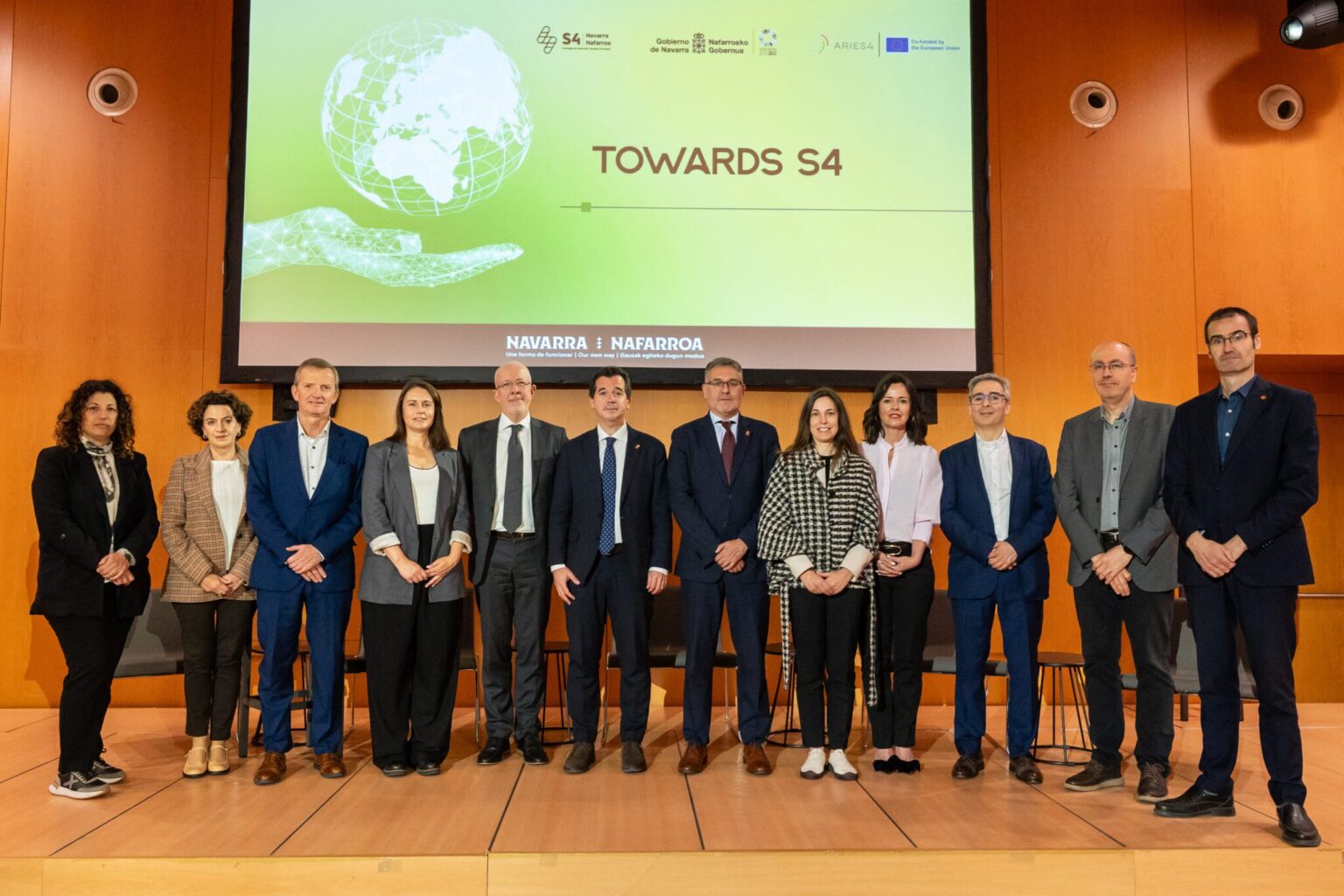
- This is reflected in the Mid-Term Evaluation coordinated by Sodena and presented during the international congress ‘TOWARDS S4’, organized as part of the European project ARIES4 this Wednesday in Pamplona, which emphasizes that “Navarra is playing a prominent role in the transition towards a more sustainable industrial model.”
- The projects ‘Navarra Zirkular’, ‘Navarra Health Cluster’, and the ‘Navarra Green Hydrogen Agenda’ are highlighted as “three case studies” that “visualize and underscore the work carried out.”
The Smart Specialization Strategy for Sustainability of Navarra (S4) shows “very positive results in all evaluated criteria” as it approaches the midpoint of its execution period (2021–2027). This is the main conclusion of the “Mid-Term Evaluation of the S4 Navarra Strategy for the 2021–2027 Period”, conducted by the consultancy Ayming, coordinated by Sodena, and presented at the closing session of the European project ARIES4 this Wednesday in Pamplona.
As part of the event, during the session “Sustainability and the Future of the Industrial Sector in Navarra”, Mikel Irujo Amezaga, Minister of Industry, Ecological Transition, and Digital Business of the Government of Navarra, stated:
“After 10 years, Navarra’s Smart Specialization Strategy continues to be a European benchmark. We believe in a regional strategy that adapts to change and can identify new strategic sectors with a global dimension. It’s not just a document — it must have a direct impact on our policies. Navarra’s industry requires the involvement not only of the economic-productive sphere but also of the knowledge ecosystem, the whole government, and society as a whole. That’s why now is the time for a new, flexible industrial law with a European scope, one that endures over time and involves the entire government.”
The evaluation, which reviews the 2021–2024 period, has confirmed compliance with the criteria set by the European Commission as enabling conditions for access to structural funds. In this way, “the strategy is seen as a catalyst for the region’s efforts toward clear objectives aligned with local strengths, such as innovation and value chain development in industry,” explained Juan Cristóbal García, Director of Regional Strategy at Sodena, who presented the report alongside Susana Elena of Ayming.
Moreover, the S4 “reflects a clear commitment to adapting to European trends, particularly in key areas such as the energy transition and digitalization,” and “there is broad consensus on the relevance of cross-cutting priorities linked to ecological and digital transitions, which are well-defined and essential to Navarra’s future.”
Sustainability is highlighted as one of the strategy’s main strengths, “especially in sectors such as green energy, electric mobility, and the circular bioeconomy.”
Governance and Participatory Models
In this context, the Smart Specialization Strategy for Sustainability of Navarra has played a significant role by “leveraging a solid governance framework and dynamic participatory models.” The report states that “Navarra is playing a prominent role in the transition toward a more sustainable industrial model.” It especially highlights the high level of collaboration achieved between the public and private sectors.
Furthermore, the strategy is said to be “well-aligned with other regional policies,” such as the draft Navarra Regional Law on Industry and Business Promotion. The report also highlights three case studies that showcase and validate the work carried out: ‘Navarra Zirkular’, ‘Navarra Health Cluster’, and the ‘Navarra Green Hydrogen Agenda’.
Ultimately, the S4 “seeks to integrate sustainability, innovation, and human-centered values to ensure balanced and resilient growth of Navarra’s industrial ecosystem.”
Recommendations
The results presented are based on an evaluation process combining primarily qualitative approaches with quantitative analyses. Regional plans and other initiatives launched by the regional government during the evaluated period were reviewed. In addition, key stakeholders from Navarra’s R&D&I ecosystem were interviewed and participated in thematic working groups and the S4 platform.
As a result of this work, a series of recommendations have been made for the second half of the implementation period (2025–2027). These include:
- Strengthening funding for applied research
- Enhancing specialized training in key areas
- Continuing support for SME digitalization
Regarding strategic priorities, it is recommended to analyze and assess emerging sectors for potential inclusion as strategic priorities.
The monitoring processes were also evaluated, with advice to incorporate new process- and priority-linked indicators. The governance model was analyzed as well, with a suggestion to increase SME representation in S4 decision-making bodies.
In terms of international projection, it is recommended to maintain and expand participation in large-scale European projects.
Finally, communication was identified as a key area, with a strong commitment to increasing awareness of the strategy through various media channels.
The evaluation concludes that S4 Navarra is progressing in all evaluated areas, with no domains showing a lack of progress. In addition to the recommendations, the evaluation acknowledges the achievements made during this initial implementation phase.
European Project ARIES4
The conclusions of the “Mid-Term Evaluation of S4 Navarra for the 2021–2027 Period” were presented during the international workshop ‘TOWARDS S4’, held on Wednesday in Pamplona. This event is part of the European project ARIES4 (Alliance of Regional Innovation Ecosystems Based on Smart Sustainable Specialization Strategies), which aims to foster cooperation and knowledge exchange among European regions committed to sustainability.
Focusing on smart specialization and aligned with the European Green Deal and the 2030 Agenda, the initiative is led by the Public University of Navarra (UPNA) and includes Sodena and the Department of Education of the Government of Navarra as partners, along with regions from Bulgaria, Denmark, and Sweden, and in collaboration with Nastat, Enercluster, and Nagrifood.
The project also aims to:
- Promote collaboration among knowledge stakeholders
- Encourage responsible business models
- Boost entrepreneurship
- Create structures that support knowledge interaction and transfer at the regional and European levels
Wednesday’s event was inaugurated by Ramón Gonzalo, Rector of UPNA, and Iñaki Larraya, Managing Director of Sodena. It included several panel discussions, such as the one on “Instruments and Policies for Implementing Sustainability”, with participation from Montse Guerrero, Deputy Director General for Sustainability and Circular Economy at Sodena, among other experts.
The closing address was delivered by Sergio Pérez, Director General of External Action of the Government of Navarra.