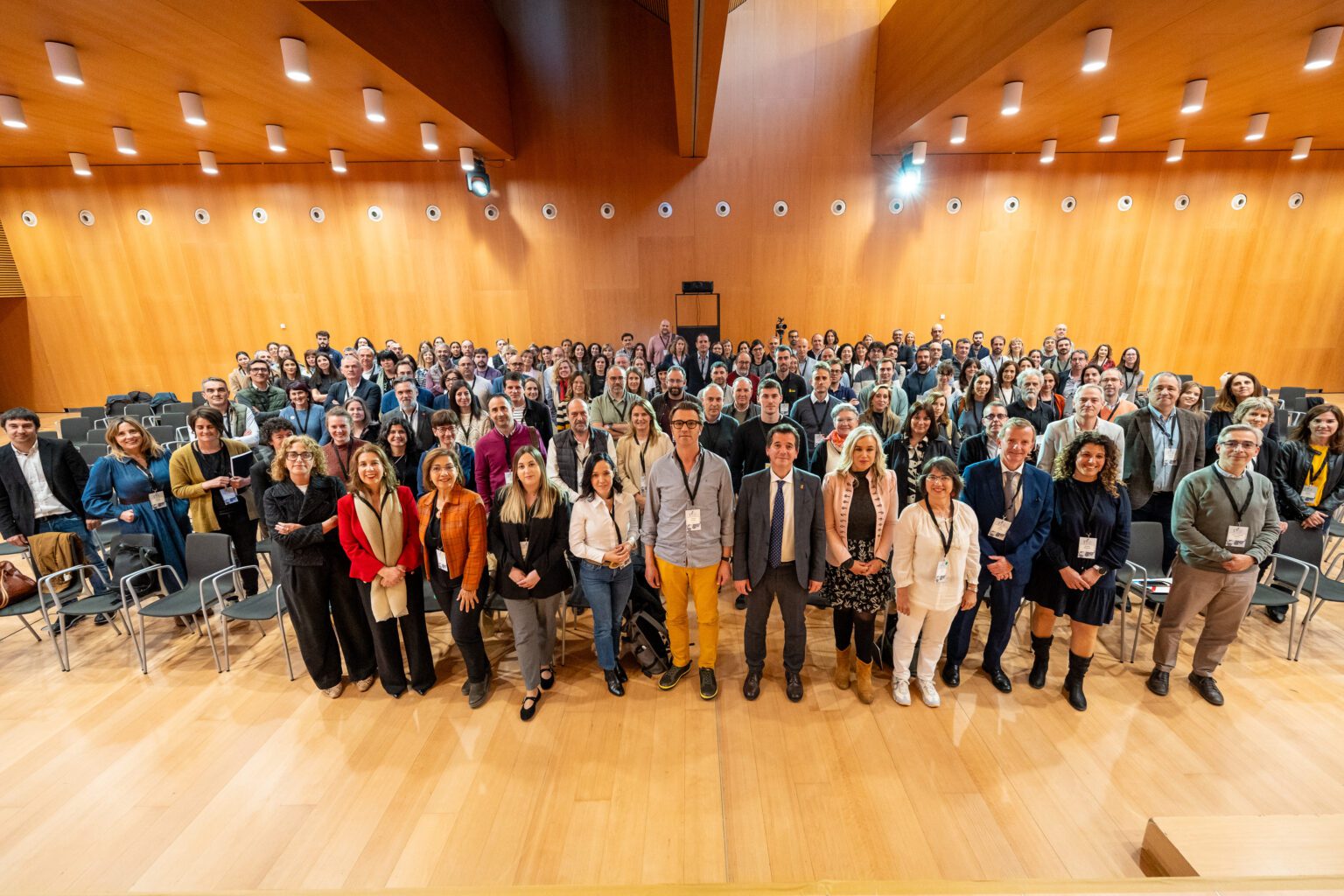
- More than 200 people participated in a professional meeting on the challenges of the industrial transition to the circular economy, as part of the European Circular Innovation Valley project
- It has 19 partner regions in nine European territories and is coordinated by the Department of Industry, Ecological Transition, and Digital Business of the Government of Navarra, with the support of Sodena.
Last Friday, the Minister of Industry, Ecological Transition, and Digital Business, Mikel Irujo, closed the working day ‘Challenges of circularity in companies’, focused on the development of the European Circular Innovation Valley (ECIV) project, of which Navarra is the leading region.
The aim of the meeting, organized in conjunction with the public company Sodena, was to identify real barriers and opportunities in the adoption of circular economy models by the Navarre business community, as well as to promote collaboration between strategic agents in the region. To this end, there was active participation from companies, the Nagrifood and Functional Print clusters, technology centers, and sector associations such as the Navarre Industry Association (AIN), which have worked together to define roadmaps for specific challenges.
In this regard, Councilor Irujo highlighted that there are new market niches in Navarre and that the circular economy is present in all of them. “In Navarre, we have three plants dedicated to recycling wind turbine components that will soon be operational in Cortes, Sangüesa/Zangoza, and Falces.” He also emphasized the transformation towards electric mobility as a result of circularity and the need to continue advancing and increasing joint participation from the entire industrial fabric.
For her part, the Director General of Energy, Business R&D&I, and Entrepreneurship, Garbiñe Basterra, highlighted the financial support that the Administration will manage to promote innovation projects in the field of the circular economy through two calls for grants that will take place in December 2025 and October 2026. “With these, we aim to increase the maturity of the technological innovation of these projects so that they can move from a TRL6 status to a final TRL8 status, which will allow them to complete tests and demonstrations to obtain certificates that will enable them to implement these solutions or access new market niches.”
Workshops based on specific challenges and sharing of results
Attendees participated in four thematic workshops focused on circularity challenges for Navarre’s industry: the industrialization of circular packaging, the revaluation of agri-food by-products, water regeneration in industrial processes, and an open space for multisectoral challenges.
At the end, the conclusions of each workshop were shared as a starting point for future lines of action by the representatives of each cluster and the director of the Strategic Projects Service of S4 and Entrepreneurship, Delia Sola.
With this conference, Navarra takes another step forward in its commitment to leading the development of a more competitive and collaborative industrial model aligned with the principles of the circular economy and ecological transition.
The next event, at Green Week 2025 in Brussels
The next event focused on the ECIV project will take place in Brussels on June 4. This event, organized by Navarra as the leading region, is part of Green Week 2025, the European Commission’s annual flagship event on environmental policies with the theme “Circular solutions for competitive Europe.”
On that day, the Regional Innovation Valleys (RIV) and the ECIV project will be presented as a framework for European interregional collaboration, promoting the transition to a circular economy for industrial competitiveness.
This event, which will take place both in person and online, will be attended by representatives from all regions participating in the project.
It will be held as part of Green Week 2025 with the aim of presenting the RIVs (Regional Innovation Valleys) and the ECIV project as a framework for European interregional collaboration, promoting the transition to a circular economy for industrial competitiveness.
Matching opportunities will also be facilitated in the circularity missions in the ECIV collaboration space.