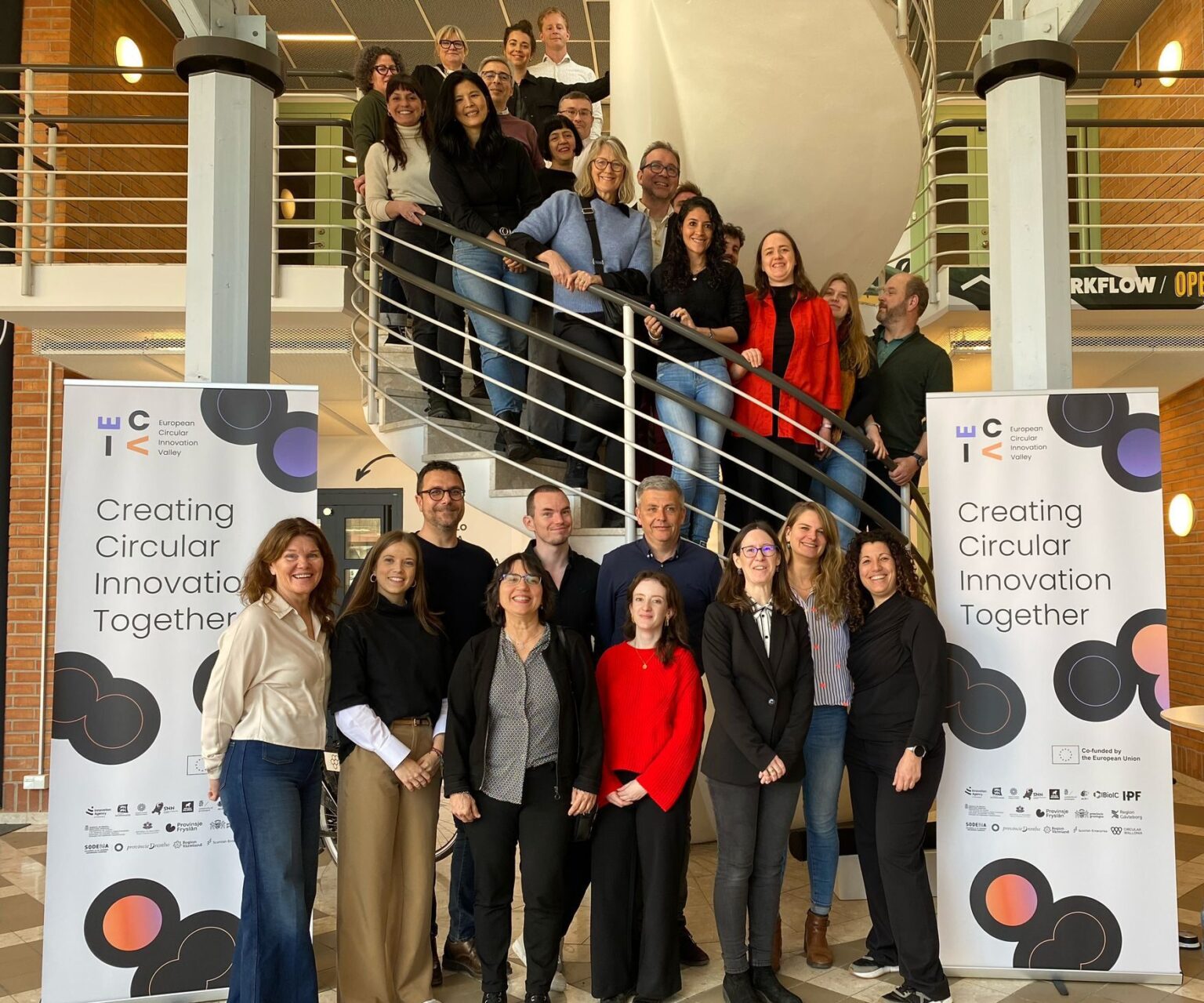
- The initiative includes 19 partner regions across 9 European territories and is coordinated by the Department of Industry, Ecological Transition and Digital Business of the Government of Navarre, with support from Sodena.
The Government of Navarre, through its Department of Industry, Ecological Transition and Digital Business, leads the European Circular Innovation Valley (ECIV) project, which aims to create an interregional circular economy ecosystem by connecting European regions.
From March 24 to 26, in-person working meetings for the project were held in Dalarna (Sweden). This event brought together representatives from the project’s 19 partners, with the goal of strengthening collaboration and advancing the definition of interregional challenges in the circular economy to accelerate Europe’s transition towards circularity. Navarre was represented by technical staff from the regional government and the public company Sodena.
The visit focused on translating sustainability goals into specific strategies for each region, which will shape industrial practices and policy development in the participating ECIV regions. During the challenge design workshop, participants refined ECIV’s working proposal for the year 2029, prioritizing five key sub-missions or challenges through structured discussions and regional voting.
These challenges will guide the development of regional action plans, ensuring that ECIV’s efforts result in measurable progress in areas such as industrial symbiosis, the bioeconomy, by-product valorization, and circular material flows. Contributions from experts at the OECD Observatory of Public Sector Innovation and the Sustainable Steel Region provided insight into best practices for scaling challenge-driven initiatives.
Unlike traditional innovation approaches, challenge-driven innovation focuses on defining specific objectives and mobilizing cross-sector collaboration to achieve them. This meeting marked a crucial step in structuring ECIV’s circular challenges and aligning them with regional and European sustainability and circular economy policies under the EU funding framework, ensuring short- and medium-term impact.
With a clear roadmap, ECIV partners will integrate these challenges into regional action plans, laying the groundwork for tangible investments and policy changes that will drive circular economy implementation across Europe.
Scaling regional circular economy models across Europe
The European Circular Innovation Valley consortium meeting focused on how successful circular economy models can be adapted and applied across different European regions. Discussions highlighted proven initiatives such as green steel production by Nordic steelmaker SSAB, the textile circularity approach of the Swedish Wool Initiative, and bioeconomy efforts in central-northern Sweden, examining how these solutions can be effectively scaled.
One key challenge addressed was how to create the right conditions for industrial symbiosis, where by-products from one sector or company become inputs for another. Representatives from various regions analyzed case studies on material reuse in manufacturing, energy recovery from industrial by-products, and resource sharing between industries. The aim is to develop frameworks that connect regional industries and facilitate knowledge transfer, ensuring that circular solutions go beyond isolated projects and are integrated into broader economic strategies.
At a time when the EU is pushing for stricter sustainability targets, ECIV’s proposal ensures that participating regions can more effectively accelerate their circular transition efforts. The next step will be to translate these discussions into regional action plans that enable the implementation of successful circular economy strategies.
European Circular Innovation Valley Project
The European Circular Innovation Valley project is a key pillar in Navarre’s circular economy strategy. The main objective of ECIV is to promote projects and applied innovations across various sectors aligned with the Smart Specialization Strategies of the participating regions. This includes energy, agri-food, automotive, construction, and machinery, among others—connecting different value chains, processes, and materials to make significant progress in the transition towards a circular economy.
With an overall budget of €27.2 million—€6.43 million of which is allocated to Navarre—the region is tasked with leading the establishment of Europe’s largest innovation ecosystem in the circular economy, fostering sustainable development and interregional collaboration across the continent.
To achieve this, ECIV works with the following regional partners and leading actors in each of the nine participating regions:
- Navarre: Department of Industry, Ecological and Digital Business Transition as coordinator along with public company Sodena
- Northern Netherlands: alliance of the provinces of Friesland, Groningen, and Drenthe
- Norra Mellansverige Region – Central-Northern Sweden: alliance of the regions of Dalarna, Värmland, and Gävleborg
- Normandy Region (France)
- Bulgaria: Ministry of Innovation and Growth
- Wallonia Region (Belgium): Walloon Public Service for Economy
- Lithuania: Lithuanian Innovation Agency
- Helsinki–Uusimaa (Finland): Regional Council
- Scotland: Scottish Economic Development Agency
All participating regions aim to implement their actions and achieve the set goals by 2029.