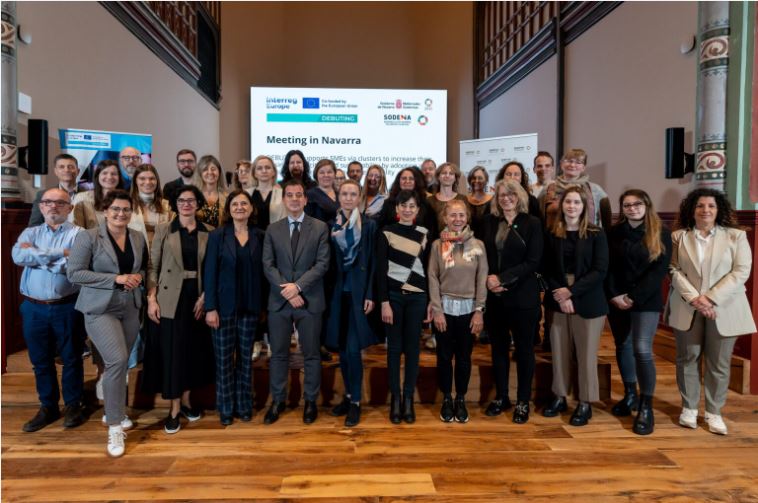
This is detailed in the first report on gender equality in the secondary sector of the region, presented on Wednesday during the meeting in Pamplona of the partners of the European Debuting project.
Almost 8 out of 10 industries in the region have taken measures to achieve gender equality. In addition, 92% consider this issue to be “important” and 73% value it as a factor of competitiveness within their sector. This is confirmed by the first ‘Study on Gender Equality in Industrial Companies in Navarre’, carried out by the Directorate General for Social Economy and Labor of the Government of Navarre and presented on Wednesday during the meeting of the partners of the European Debuting project (Development Business Through Inclusiveness and Gender Awareness) in the former Salesas convent in Pamplona.
The event was attended by the Regional Minister for Industry and Ecological and Digital Business Transition, Mikel Irujo Amezaga, and began with a welcome speech by the Deputy Director of Sustainability and Circular Economy at Sodena, Montse Guerrero. In her speech, she highlighted that “Navarra currently tops the national ranking in terms of the highest quality of life among all Spanish regions; it is a leading region that continues to promote gender equality in its companies as a fundamental element in strengthening its competitiveness.” She also pointed out “the importance of ensuring this equality in two crucial transitions for companies: the ecological and digital transitions.”
For his part, the Minister of Industry and Ecological and Digital Business Transition, Mikel Irujo, stated that “in the transformation we are experiencing as a society, the commitment to equality must be a key element for a fair industrial transition. A transition that addresses the current lack of talent and takes advantage of the opportunity to establish the role of women in industry to strengthen its competitiveness.”.
Irujo made his statements before representatives from nine European regions which, together with Navarre, are participating in the Debuting project. This initiative aims to incorporate gender equality as a factor in the competitiveness of
companies by improving or developing public instruments. To achieve this goal, it has a total budget of €2.4 million until 2026 and 80% co-financing from the Interreg Europe interregional cooperation program. The budget allocated by Navarre, for its part, amounts to €205,000.
Debuting has called its partners to a meeting to exchange best practices, which will take place over the next three days in the region. Representatives from the regions of Värmland (Sweden), Lapland (Finland), North-Vest (Romania), Lower Austria (Austria), Magyarország (Hungary), Emilia-Romagna (Italy), Pomorskie (Poland), Grand Est (France), and Baden-Württemberg (Germany) are participating in this meeting.
The Navarre delegation was responsible for organizing the event. Specifically, Sodena was in charge of this task, with the collaboration of the Directorate General for Social Economy and Labor and the Navarre Institute for Equality (INAI). The representation of the regional government was completed by the presence of the Navarre Employment Service-Nafar Lansare (SNE-NL), the Directorate General for Vocational Training, Digitalization, and Educational Services, the Public University of Navarre (UPNA), the Navarre Business Confederation (CEN), the Association of Women Entrepreneurs and Executives of Navarre (AMEDNA), the Spanish Association of Management and People Development (Aedipe), and the Enercluster and Functional Print clusters.
THE STUDY, IN DETAIL
A total of 874 industrial companies in the region and 1,294 professionals, including senior management (364), middle management (455), and employees (475), participated in the first ‘Study on Gender Equality in Industrial Companies in Navarra’, presented on Wednesday.
All respondents agree that their sector is very male-dominated in management. This is demonstrated by the following data collected in this research: “Management is equal in only 22% of companies, while in 68% of companies, managers are mainly men.” Likewise, middle management, technical staff, and, above all, operators are male-dominated. On the other hand, they highlight that “administrative positions are feminized in 53% of the companies surveyed.”
Despite everything, 92% consider equality between men and women to be “important.” Not only that, but 73% value it as a factor of competitiveness within their sector, which has led to almost 8 out of 19 (79%) deciding to implement measures favorable to equality within their organization.
On the other hand, in terms of remuneration, the authors point out the following significant fact: “The salary for the same position is equal between men and women for 87% of companies.” The report also confirms that the imbalance in remuneration “barely reaches 3%” and that it is the agri-food industry “where there is the greatest wage balance.” In fact, according to the study, “the agri-food, chemical, pharmaceutical, and plastics industries are the ones that have made the most positive progress in terms of equality.”
However, the absence of women in management positions and the fact that they are the ones who, for the most part, take advantage of reduced working hours shows, according to the authors of the study, that when it comes to the wage gap, “there is still a long way to go.”
Added to this is the fact that the majority of new hires in the last
three years have been men. This is not perceived as inequality by the sector, but rather as the result of more men applying for the various jobs on offer. “Internal promotions are also a consequence of the masculinization of the workforce. Therefore, the starting point for real equality in the company is equal training,” they add.
ALTERNATIVES TO THE EQUALITY PLAN
The report also confirms that the most common work-life balance measures are equal pay (65%), flexible working hours (60%), and equal promotion of men and women (48%). It also shows that chemical, pharmaceutical, plastics, and machinery manufacturers have the most difficulty achieving effective equality, mainly due to “the lack of professionals of both sexes.”
As for the actions taken by companies in the area of equality, six out of ten have a protocol for preventing and dealing with harassment. And four out of ten have an equality plan. “Non-mandatory” is the main reason given by companies that have not developed this protocol. In these cases, to compensate for this shortcoming, corporations implement measures such as equal pay within their workforces, the aforementioned flexible working hours to achieve work-life balance, or, where appropriate, the equal promotion of men and women.
CONCLUSIONS AND LINES OF WORK
Based on the data obtained during their research, the authors conclude that “medium and large companies and those run by women take more measures to achieve equality.” They also highlight that, in the latter, “job evaluation systems, anti-harassment protocols, the promotion of a balanced use of work-life balance measures, and the use of inclusive language in company communications are more prevalent.”
On the contrary, “small companies (with fewer than 50 employees) or those with more mature management teams maintain a more conservative attitude,” they add. Hence, among the lines of action proposed to reverse this situation, they emphasize the need to “promote industrial studies among women, break stereotypes, encourage women’s leadership in industry, and communicate the support provided by the public administration in terms of equality.”
They also call for “raising awareness among companies to attract women, improving the inclusive image of companies, finding evidence of improved competitiveness through equality, and increasing joint responsibility.” In short, “it is time to move from obligation to commitment,” they conclude.
OTHER EVENTS AT DEBUTING IN NAVARRA
Following the presentation of the ‘Study on Gender Equality in Industrial Companies in Navarra’, Wednesday’s session was rounded off with a presentation by Leyre Catalán, engineer and associate professor at the UPNA, who outlined the work her center is doing on equality through the ‘Women, Science, and Technology’ Chair.
Sodena also presented the latest advances made in the region within the framework of the Sustainable Strategy for Smart Specialization (S4), as well as the recent designation of Navarre as the leader of the “regional innovation valleys in the circular economy” or “European Circular Innovation Valley-ECIV.”
After this first day, the Debuting representatives will continue their working sessions tomorrow, Thursday, at Cenifer (National Reference Center for Renewable Energy and Energy Efficiency). This vocational training center will host a presentation on the gender situation in vocational training, a professional profile that feeds a large part of Navarre’s industry. There, representatives of the Association of Women Entrepreneurs and Executives of Navarra (AMEDNA) will present the Reconcilia seal and the InnovaRSE program, whose objectives include promoting work-life balance and corporate social responsibility in the private sector in Navarra. In addition, there will also be a space for debate on budgets with a gender perspective and, in parallel, there will be a discussion on the implementation of smart specialization strategies.